Set the Controls for the Heart of the Sun

Today, Quito will become the closest city on planet Earth to the Sun; it is the Equinox.

This weekend, we visited Mitad del Mundo, the middle of the world.  Commonly referred to as the Equator.  Near Quito, there are two prominent celebrations of this.  The first, established some time ago, is presented with great pomp and circumstance, complete with flowered gardens, stone walkways, and a four story tower with an observatory.  The second is 250 meters away from the more well known line, was discovered eighteen years ago with GPS, and is the exact middle of the earth.  This true Equatorial line is complete with experiments to illustrate the effects and significance of this very real line.  Balancing acts, two sided sun dials, and tubs of draining water that illustrate the opposing Coriolis effects on the different sides of the equator.

My favorite picture below shows my hand over a sun dial.  We were so close to the Equinox that the sun dial cast nearly no shadow.  Today at noon CST the sun dial will cast no measurable shadow and the earth will be in balance.

The Coriolis Effect causes counter clockwise rotation in the Northern Hemisphere (Tornado) and clockwise rotation in the Southern Hemisphere (Typhoon).  However, at the equator, this rotation does not exist.  To illustrate, see the video below to watch water in a basin drain straight down with no vortex.  The leaves fall straight through.  Amazing.


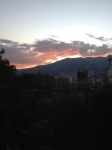
Alpenglow

Since the equator run directly through Quito, sunrise is at 6 AM and sunset is at 6 PM every day of the year. This is taking us a little while to get used to but the sunsets are beautiful just like in Crested Butte.

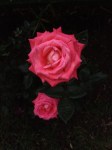
The rose bushes in our yard are amazing. They are in full bloom and we notice new buds on them everyday. Even Lucy enjoys sniffing them when she goes out into the yard.


Note to Self: Watch out for Ecuadorian hot dogs

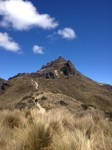
While Roman has been in Mammoth, California this last week for the annual Black Tie Retreat, Lucy and I have been muddling through life in Quito. We went on a fun mountain bike ride in Parque Metropolitano on Saturday and enjoyed a Tanzanian/German/Ecuadorian (how’s that for a fusion restaurant!) lunch at a local restaurant with some friends. Saturday evening, my friend Amanda had a barbecue at her apartment a few blocks away. Just as I was into the second bite of my hot dog, thinking to myself “this is one miserably tough casing on this thing”, my friend Shannon said, “I had a hot dog the other day and I had to remove the plastic covering on it.” Needless to say, that tough casing wasn’t just a casing after all. I think I will stay away from hot dogs for a while.

A Nice Little Weekend- Part 2

Like I’ve been saying, “We put a nice little weekend together”.  After the botanical garden, Betsy and I took a 15 minute cab ride to Nayon, a sleepy town east of Quito and down the hill.  Right away Nayon felt more like our pace.  The main industry of this small town is selling greenhouse plants.  The gardener we purchased our plants from, Juan, is a third generation gardener and also does work for the school.  It was hard to decide, but we got a few things we had always wanted but never had because of the sheer expense in the states or how restricted the environment was back home.  In the end, we purchased two different palms, four rose plants, a lime tree, an orange tree, some tomato plants, and azalea bush.  Juan even loaded up everything in his brother’s pick up truck, drove us home, and helped us plant the rose bushes.  Amazing.

A Nice Little Weekend- Part 1

We put a nice little weekend together.  On Saturday, we took the ten minute walk from our apartment to Jardin Botanico, an 18,000 square meter botanical garden in Parque Carolina.  There were many areas containing various trees, bushes, flowers, and cacti.  The highlight was definitely the Orchid rooms, which consisted of two separate greenhouses of differing climates.  Coming in as a close second was a humid greenhouse containing carnivorous plants.  In the slideshow, these are the tubular shaped flowers.  The two species below traps insects by either drowning them at the bottom of the flower or closing a lid, trapping the insect.  I’m definitely going to keep my head on a swivel in the jungle.